Varieties
1509 vs 1718 Basmati rice: which one is better for export and consumption?
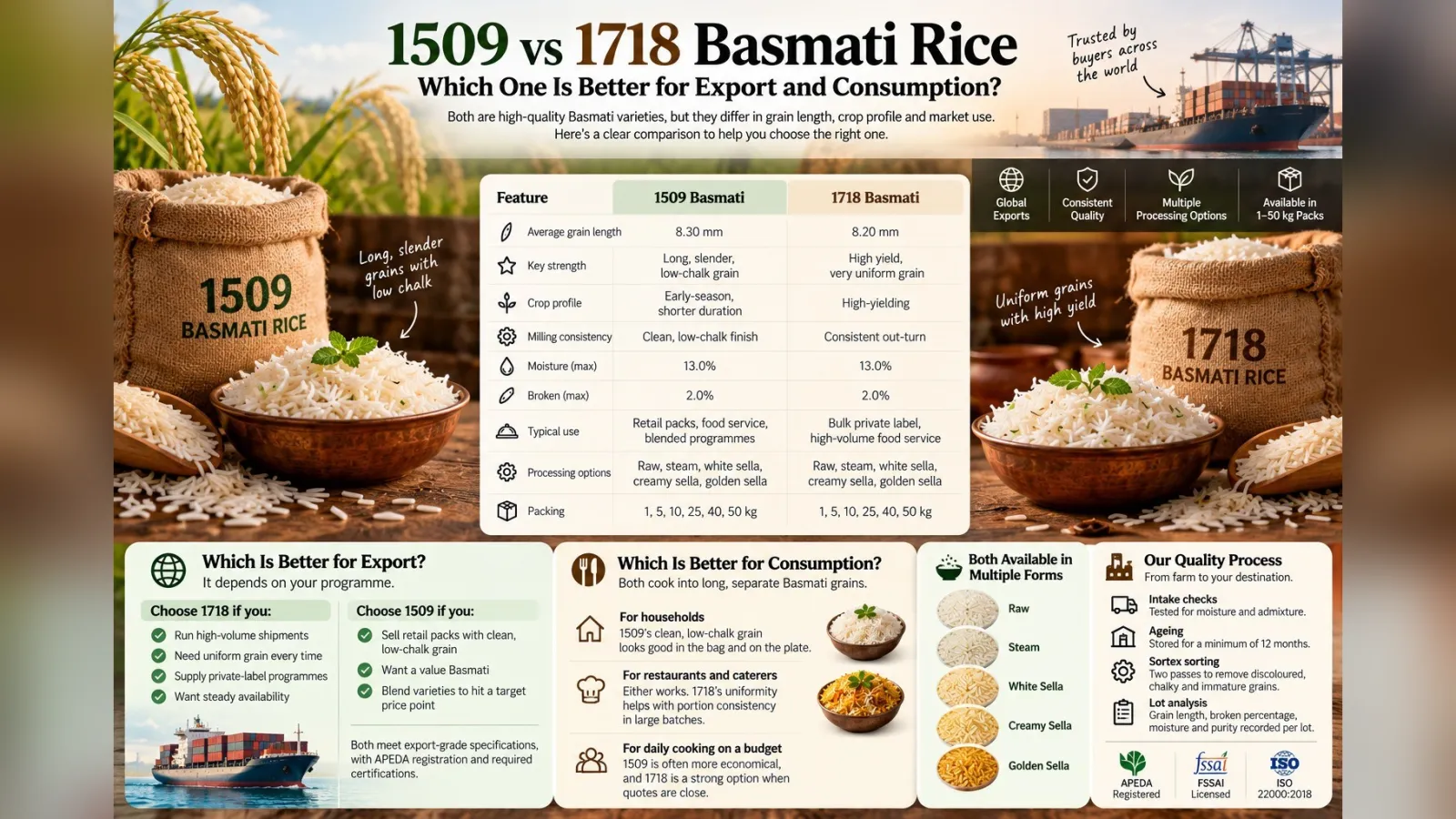
Neither is better in every case. 1509 Basmati (8.30 mm) is a long, slender, early-season grain with low chalk, suited to retail packs, food service and blended programmes. 1718 Basmati (8.20 mm) is a high-yielding variety known for very uniform grain and consistent milling out-turn, which makes it a strong fit for bulk private label and high-volume food service. For export, 1718 favours steady supply and consistency, while 1509 favours clean grain appearance and value. For home cooking, both give genuine Basmati quality.
Importers and kitchens often ask which of these two to buy. The answer depends on your volume, your brand and how the rice will be cooked. This guide compares them using the specifications we record at our Karnal mill.
What is 1509 Basmati rice?
1509 is a long, slender, early-season Basmati with clean, low-chalk grain. Its average grain length is 8.30 mm. Because it matures early, it is a shorter-duration crop than 1121, which generally helps availability. It is also usually a notch more affordable than 1121, which is why buyers treat it as a smart alternative when price or supply makes 1121 harder to place.
Typical uses are retail packs, food service and blended programmes. See the full specification on our 1509 Basmati rice page.
What is 1718 Basmati rice?
1718 is a high-yielding Basmati with very uniform, long grain and consistent milling out-turn. Its average grain length is 8.20 mm. Higher field yield can mean steadier availability and pricing across a season, which matters to buyers who place repeat orders.
Typical uses are bulk private label and high-volume food service. Details are on our 1718 Basmati rice page.
1509 vs 1718 Basmati: side-by-side comparison
| Feature | 1509 Basmati | 1718 Basmati |
|---|---|---|
| Average grain length | 8.30 mm | 8.20 mm |
| Key strength | Long, slender, low-chalk grain | High yield, very uniform grain |
| Crop profile | Early-season, shorter duration | High-yielding |
| Milling consistency | Clean, low-chalk finish | Consistent out-turn |
| Moisture (max) | 13.0% | 13.0% |
| Broken (max) | 2.0% | 2.0% |
| Typical use | Retail packs, food service, blended programmes | Bulk private label, high-volume food service |
| Processing options | Raw, steam, white sella, creamy sella, golden sella | Raw, steam, white sella, creamy sella, golden sella |
| Packing | 1, 5, 10, 25, 40, 50 kg | 1, 5, 10, 25, 40, 50 kg |
These are typical trade specifications for the current crop year. The analysis report that ships with each lot is the binding one.
Which is better for export?
Export buyers care about three things: consistency from lot to lot, reliable supply, and a grain that presents well on the shelf. Both varieties meet the same moisture and broken tolerances, so the choice comes down to what your programme needs.
Choose 1718 for export if you:
- Run recurring, high-volume shipments where consistency matters most
- Supply private-label programmes that need uniform grain every time
- Want a hedge against seasonal price swings on 1121
Choose 1509 for export if you:
- Sell retail packs where clean, low-chalk grain is part of the appeal
- Want a value Basmati that sits close behind 1121 on length
- Blend varieties to hit a target price point
Because 1718 was bred for yield, the price gap between varieties can shift from season to season. Do not assume last season's gap still holds. Ask for a side-by-side quote before you commit.
Lots destined for export from our mill ship under APEDA registration. Halal and phytosanitary certificates are issued per consignment, and we load at Mundra, Kandla, Nhava Sheva and Pipavav. Browse the countries we supply on our export markets page.
Which is better for consumption?
At the table, both varieties cook into long, separate Basmati grains. The practical differences are small, so match the rice to how you buy and cook.
- For households and premium retail packs: 1509's clean, low-chalk grain looks good in the bag and in the pot.
- For restaurants and caterers: either works. 1718's uniformity helps when portion consistency across large batches matters.
- For daily family cooking on a budget: 1509 is often the more economical pick, and 1718 is worth comparing when quotes are close.
If you want the most dramatic elongation for biryani service, 1121 is the longest-grain commercial Basmati. For a closer look at all three, read our guide to 1121 vs 1509 vs 1718 Basmati.
Raw, steam or sella?
Both varieties come in five forms: raw, steam, white sella, creamy sella and golden sella. Sella rice is parboiled before milling, which makes the grain harder and less likely to break. Caterers and bulk buyers often prefer sella for its consistent yield in large-batch cooking. Raw and steam suit retail and everyday home use.
How we check quality before shipping
- Intake checks: every truck is tested for moisture and admixture before unloading.
- Ageing: Basmati paddy is stored for a minimum of twelve months before milling.
- Sortex sorting: two passes remove discoloured, chalky and immature grains.
- Lot analysis: grain length, broken percentage, moisture and purity are recorded per lot and travel with your consignment.
We hold APEDA registration, an FSSAI licence and ISO 22000:2018 certification.
Frequently asked questions
What is the difference between 1509 and 1718 Basmati rice?
1509 has a slightly longer grain (8.30 mm vs 8.20 mm) and is an early-season variety with low-chalk grain. 1718 is high-yielding, with very uniform grain and consistent milling out-turn.
Which is better for export, 1509 or 1718?
1718 suits recurring bulk and private-label programmes that need steady supply and uniform grain. 1509 suits buyers who want clean, low-chalk grain at a value price point.
Which is cheaper, 1509 or 1718 Basmati?
Prices move with the mandi and the crop season, so neither is always cheaper. Request a side-by-side quote for your quantity and packing.
Are 1509 and 1718 available in small packs?
Yes. Both come in 1, 5, 10, 25, 40 and 50 kg packs. Households can order a single pack with no minimum, and trade orders start at one tonne of a single variety.
Can I get both as sella rice?
Yes. Both are available as raw, steam, white sella, creamy sella and golden sella.
Get a quote for 1509 or 1718 Basmati rice
Rice rates move with the mandi, so we quote against your actual requirement: variety, quantity, packing and delivery address. Tell us what you need and we will confirm price and availability within one working day.
Call +91 98186 10679 or email export@omprasadamglobal.com.