Buying guide
Basmati vs Non-Basmati rice: a complete buyer’s guide
If you’ve ever stood in front of a rice shelf — or scrolled through a supplier’s price list — and wondered why one bag costs three times as much as another, the answer usually comes down to one thing: Basmati vs Non-Basmati. Both are excellent rice, but they’re grown differently, milled differently, cook differently, and are meant for different meals. Understanding the difference helps you buy the right variety instead of just the more expensive one.
What makes Basmati rice different?
Basmati is a long-grain aromatic rice grown mainly in the foothills of the Himalayas, across parts of Punjab, Haryana and Uttar Pradesh. What sets it apart isn’t just the region — it’s three specific traits:
- Grain length. Basmati grains are long and slender, typically between 7.2mm and 8.4mm before cooking, and they elongate further once cooked without breaking apart.
- Ageing. Genuine Basmati paddy is aged for a minimum of twelve months before milling. This reduces moisture content and firms up the starch structure, which is what gives cooked Basmati its light, separate, fluffy texture instead of a sticky one.
- Aroma. Basmati contains a naturally occurring aromatic compound that gives it its signature fragrance — something Non-Basmati varieties don’t have.
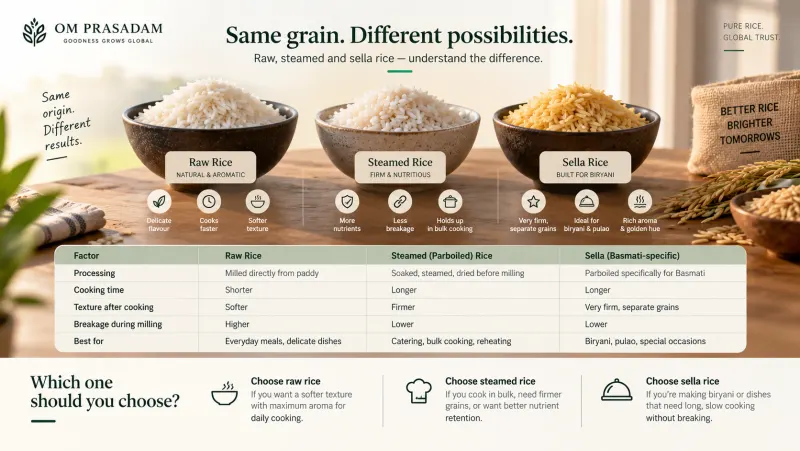
Within Basmati itself, there are multiple varieties — 1121, Pusa, 1509, 1401 and 1718 — each with slightly different grain length, aroma intensity and price point. You can see how they compare on our Basmati rice range, including specifications for raw, steam, and sella (parboiled) forms.
What is Non-Basmati rice, then?
Non-Basmati is a broad category covering everything that isn’t Basmati — and it’s just as important in Indian kitchens, if not more so for everyday cooking. Varieties like Sona Masoori, IR 64, Sharbati, Sugandha and PR 11 are shorter or medium grain, don’t carry the same aroma, and are priced significantly lower.
That doesn’t mean lower quality — it means a different purpose. Non-Basmati rice is:
- More affordable for daily household consumption
- Preferred for South Indian cooking (idli, dosa batter, plain steamed rice)
- The standard choice for canteens, catering and high-volume cooking, where consistent cooked yield matters more than aroma
- Available in raw and parboiled (steam) forms, depending on regional cooking preference
You can browse the full specification sheet for these varieties on our Non-Basmati rice range page, including grain length, moisture and broken percentage for each.
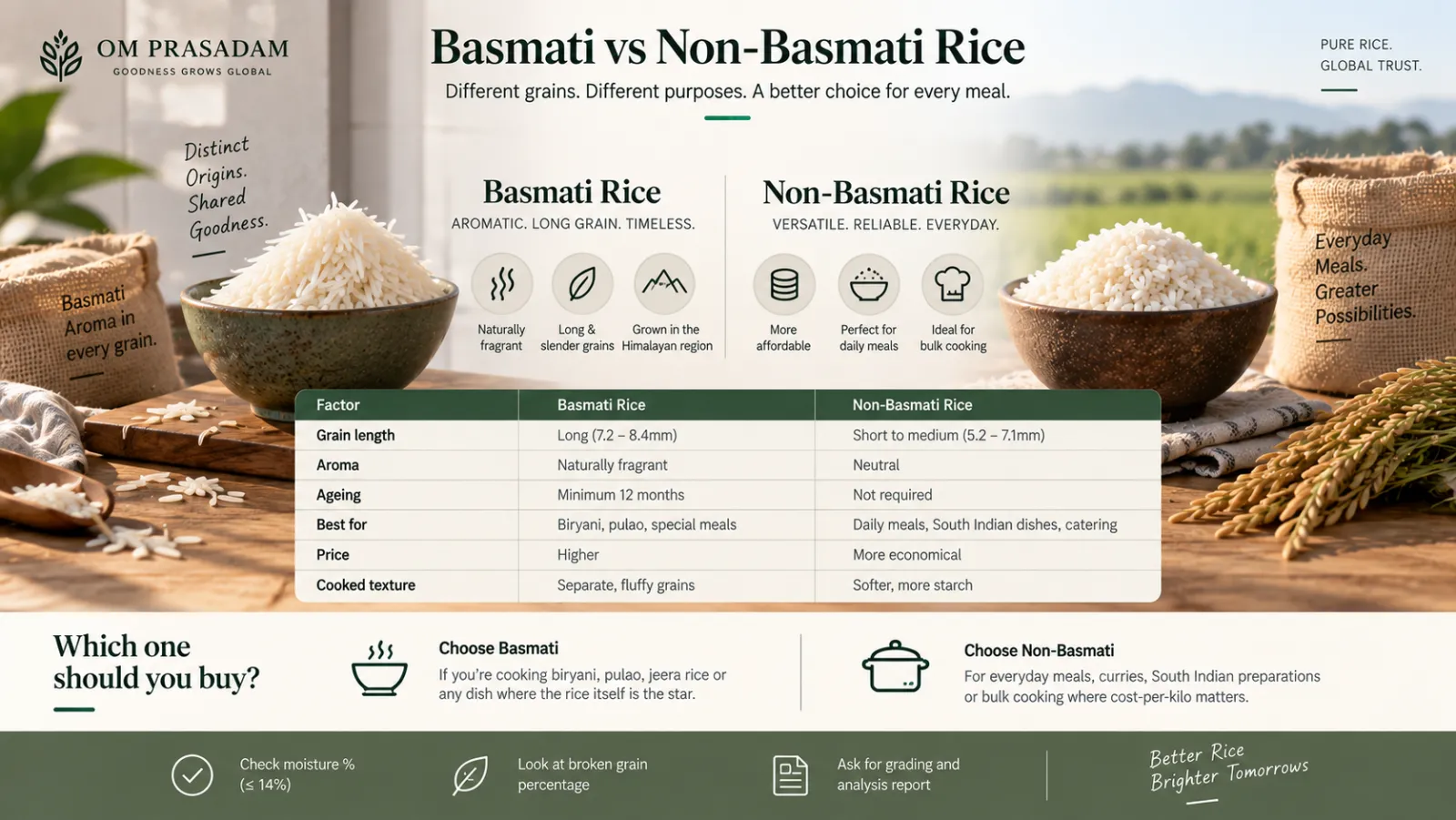
Basmati vs Non-Basmati: a side-by-side look
| Factor | Basmati | Non-Basmati |
|---|---|---|
| Grain length | Long (7.2–8.4mm) | Short to medium (5.2–7.1mm) |
| Aroma | Naturally fragrant | Neutral |
| Ageing | Minimum 12 months | Not required |
| Best for | Biryani, pulao, special meals | Daily meals, South Indian dishes, catering |
| Price | Higher | More economical |
| Cooked texture | Separate, fluffy grains | Softer, more starch |
So which one should you buy?
It genuinely depends on what’s going into your pot.
Choose Basmati if you’re cooking biryani, pulao, jeera rice, or any dish where the rice itself is the star and needs to look and smell the part. Golden sella and creamy sella (parboiled Basmati forms) are popular for biryani specifically, because the grains hold their shape well during slow cooking.
Choose Non-Basmati for everyday steamed rice, curries, South Indian preparations, or any situation where you’re cooking in volume and cost-per-kilo matters — a household eating rice daily, or a kitchen serving dozens of covers a day.
Many households and businesses actually buy both — Basmati for special occasions and guests, Non-Basmati for daily meals. If you’re unsure which grade or variety suits your specific use case, our team can walk you through it based on how you’re cooking and how often.
A quick note on quality regardless of type
Whichever category you choose, the same quality checks apply: look for the moisture percentage (rice above 14% moisture spoils faster), check the broken grain percentage, and ask whether the lot comes with a grading and analysis report. A supplier who can show you this paperwork — rather than just quoting a price — is one worth trusting.