Specifications
What grain length tells you about rice quality
Walk into any rice conversation between traders or millers, and grain length comes up almost immediately. It’s printed on grading dockets, quoted in specification sheets, and often the very first number a buyer asks about. But if you’re buying rice for your kitchen or your business, you might be wondering: does grain length actually matter, or is it just a technical detail? The short answer — it matters more than most buyers realize, and it tells you far more than just “how long is the grain.”
Grain length is a classification, not just a measurement
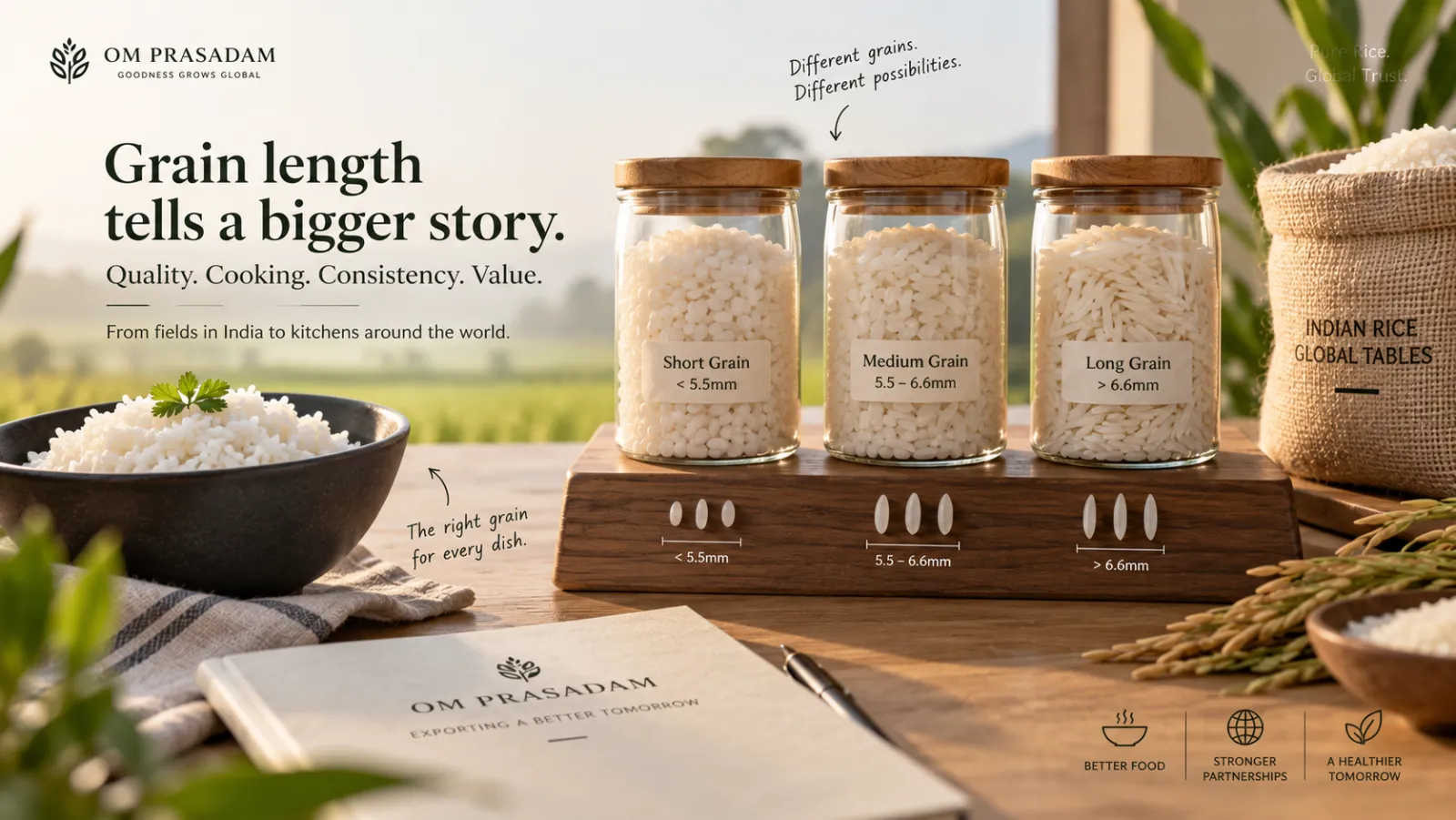
Rice is generally classified into three categories based on the length of the milled (uncooked) grain:
- Short grain — under 5.5mm
- Medium grain — 5.5mm to 6.6mm
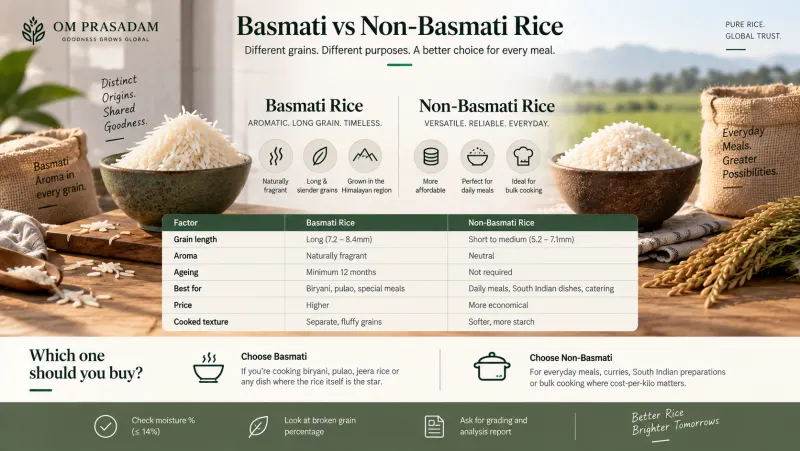
- Long grain — above 6.6mm, with premium Basmati varieties reaching 7.2mm to 8.4mm
This single measurement is one of the first things a mill records for every lot, because it directly affects everything downstream — cooking behavior, market category, and price.
Why grain length affects how rice cooks
Longer grains, particularly aged Basmati, elongate significantly during cooking — often extending to nearly double their raw length — while staying separate and firm rather than clumping together. This is why Basmati is prized for biryani and pulao: the grain holds its shape and structure even after prolonged cooking.
Shorter and medium grain rice, by contrast, tends to absorb more water relative to its size and release more starch, which is exactly why it works well for dishes that benefit from a softer, slightly stickier texture — idli, dosa batter, or everyday steamed rice eaten with curries.
Neither behavior is “better” in an absolute sense — it’s about matching the grain to the dish. Buying a long-grain Basmati for a recipe that calls for a stickier medium-grain rice, or vice versa, is one of the most common mismatches we see from first-time bulk buyers.
Grain length as a quality signal — what to actually check
Beyond just categorizing rice, grain length (and its consistency) tells you something important about milling quality:
- Uniformity matters as much as length. A lot with grains that are mostly 8.3mm but scattered with shorter, broken pieces indicates poor sorting. A well-milled lot should show consistent length across the batch.
- Length ties directly to broken percentage. Longer grains are more fragile during milling and transport, so a supplier claiming premium grain length should also be able to show a correspondingly controlled broken percentage — typically under 2% for good quality Basmati.
- Elongation after cooking is the real test. Raw grain length tells you the starting point, but the elongation ratio (how much it stretches when cooked) is what actually determines the eating experience. This is why ageing matters — properly aged Basmati elongates further than fresh-milled grain of the same raw length.
You can see how this plays out across our stock by checking the specification table on our Basmati rice range, where grain length, moisture and broken percentage are listed per variety — 1121 at 8.35mm, 1509 at 8.30mm, Pusa at 7.45mm, and so on.
Does grain length apply the same way to Non-Basmati rice?
Grain length still matters for Non-Basmati varieties, though the benchmarks and expectations are different. Varieties like Sona Masoori (around 5.2mm) or IR 64 (around 6.2mm) are shorter by design and aren’t meant to compete on elongation — instead, uniformity and controlled broken percentage matter more, since these varieties are typically bought in volume for daily cooking or catering, where consistent cooked yield across every batch is the priority. You can review these figures on our Non-Basmati rice range page.
A simple rule when you’re comparing suppliers
If a supplier quotes you a grain length figure without also sharing broken percentage and moisture content, ask for it. Grain length in isolation is an incomplete picture — it’s the combination of length, uniformity, low breakage, and proper moisture that actually determines whether the rice will cook the way it’s supposed to, and whether that quality will be consistent from the first bag to the last.